

KNOWLEDGE AND PRACTICE · DELIVERY TERMS
FCA delivery terms — Incoterms 2020
FCA means delivering the goods to the carrier or another person nominated by the buyer. The place of delivery determines the loading obligation and when risk transfers. Check both variants and the division of customs formalities.
Published: Updated:
FCA AT A GLANCE
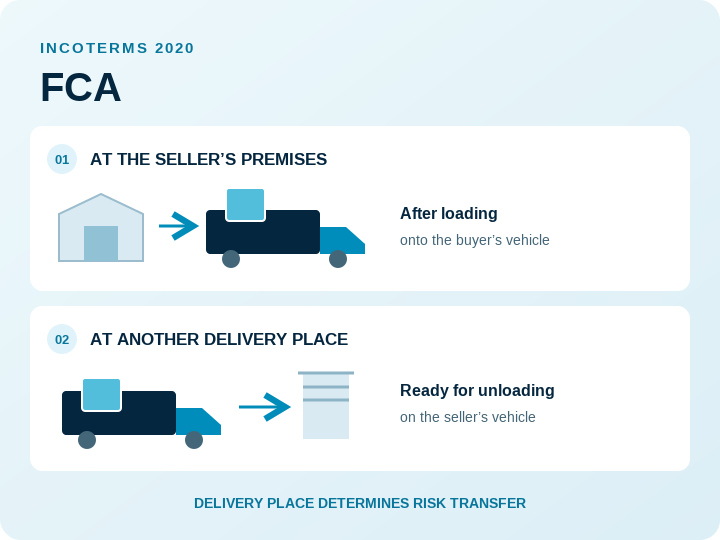
The seller prepares the delivery and export customs clearance. The buyer arranges onward carriage. Specify the exact place: delivery at the seller’s premises includes loading; delivery elsewhere takes place on the seller’s vehicle, ready for unloading.
What does FCA Incoterms 2020 mean?
FCA (Free Carrier) means “Free Carrier” followed by the named place of delivery. The seller delivers the goods to the carrier or another person nominated by the buyer. How the place is specified determines the precise obligations when handing over the goods.
FCA can be used for any mode of transport, including journeys combining several modes. It is not restricted to road or sea transport. If you are also comparing an EXW offer, note the differences in loading and export customs clearance.
FCA — two variants of delivery and risk transfer
VARIANT 01
At the seller’s premises
The goods are delivered once loaded onto the means of transport arranged by the buyer. The seller is responsible for loading and generally bears the risk until it is completed.
VARIANT 02
At another named place
The seller transports the goods to that place. Delivery takes place when the goods are on the seller’s means of transport, ready for unloading and at the disposal of the carrier or person nominated by the buyer.
Risk transfers to the buyer at the selected delivery point, and the buyer generally bears further costs from that point. This does not mean that the goods have reached the final recipient. Under FCA, delivery may take place at the seller’s premises or at a terminal at the start of the journey.
| Area | Who is responsible? |
|---|---|
| Preparation for delivery | The seller, including suitable packaging and marking for transport. |
| Loading at the seller’s premises | The seller — when the seller’s premises are the named place of delivery. |
| Carriage to another FCA point | The seller — making the goods available on the seller’s vehicle, ready for unloading. |
| Onward carriage | The buyer, unless it is agreed that the seller will contract carriage at the buyer’s cost and risk. |
| Customs formalities | Seller: export. Buyer: transit and import, where formalities are required. |
How should the FCA place of delivery be specified?
A town name alone is not always enough. Specify the address and exact point: a warehouse loading bay, terminal gate or another agreed handover location. A precise point determines when delivery is completed, where risk transfers and from where the buyer bears further costs.
TWO FICTIONAL WORDING EXAMPLES
FCA seller’s warehouse, ul. Przykładowa 10, Białystok, loading bay 2, Incoterms® 2020The seller loads the goods onto the vehicle arranged by the buyer.
FCA terminal X, address and receiving point, Incoterms® 2020
The seller brings the goods to the terminal on the seller’s means of transport and makes them available, ready for unloading, to the carrier or person nominated by the buyer.
If no precise point is specified within the agreed place and several points are available, the seller may be entitled to choose. Also agree the carrier, collection time, vehicle and safety requirements in advance.
FCA — export customs clearance, transit and import
The seller carries out and pays for required export customs clearance. The buyer is responsible for required transit and import customs formalities, including duties and relevant authorisations. Each party also has obligations to assist the other in obtaining documents and information.
If you sell FCA goods outside the EU, agree the documents, planned collection and presentation of the goods with your customs agent. When buying FCA from outside the EU, also prepare formalities in the import country and transit arrangements if needed. The FCA delivery place does not replace agreement on where goods are presented to customs authorities.
The rule governs the relationship between the parties to the sale. Requirements for the exporter, importer and customs representative derive from the applicable law. The FCA term alone does not grant authority to represent a party before customs.
FCA and the on-board bill of lading
In transactions involving sea carriage, the seller or bank may need a bill of lading confirming loading on board the vessel. Under FCA, however, the goods may have been delivered to the buyer earlier — before being loaded on board.
Incoterms 2020 provides the A6/B6 option: the parties may agree that the buyer, at the buyer’s cost and risk, instructs the carrier to issue an on-board bill of lading to the seller after loading on the vessel. If issued, the seller passes it to the buyer, often through the banking process.
This option does not move the FCA delivery point or risk transfer onto the vessel. The required document and the carrier’s ability to provide it must be agreed in advance. This does not automatically make the seller responsible to the buyer for the terms of the contract of carriage.
FCA, EXW or FOB — what should you compare?
| Area | FCA | EXW | FOB |
|---|---|---|---|
| Mode of transport | Any, including multimodal | Any | Sea and inland waterway |
| Standard delivery point | Carrier / buyer’s nominee at the agreed point | Goods made available, with no loading obligation | Goods on board the vessel at the named port of shipment |
| Export customs clearance | Seller | Buyer | Seller |
| Main carriage | Buyer | Buyer | Buyer |
If goods are handed to a carrier or terminal before loading on the vessel, compare the practical use of FCA and FOB. Do not choose FOB just because part of the journey is by sea. Also check EXW against the buyer’s actual ability to carry out export formalities in the seller’s country.
DETAILED DIVISION OF RESPONSIBILITIES
FCA — seller’s and buyer’s obligations
Ten areas, A1–A10 and B1–B10, let you examine both sides of the same delivery. Compare seller and buyer duties in each area, from delivery and documents to costs and notices. This is a discussion of the rule, not a sales contract or the full ICC publication.
01 General obligations
A1 · Seller
The seller provides the goods, commercial invoice and any other documents required by the sales contract.
B1 · Buyer
The buyer must pay the price specified in the sales contract.
02 Delivery
A2 · Seller
The seller must deliver the goods to the carrier or another person nominated by the buyer at the named point, if specified, or procure goods already delivered in this way.
The seller must deliver on the agreed date or at the time within the agreed delivery period notified by the buyer for the nominated carrier or person to take the goods. If neither is fixed, delivery must be by the end of the agreed period.
Delivery is completed:
- if the named place is the seller’s premises — when the goods have been loaded onto the means of transport provided by the buyer;
- in any other case — when the goods are placed at the disposal of the carrier or another person nominated by the buyer on the seller’s means of transport, ready for unloading.
If the buyer has not specified a point, the seller chooses the point that best suits the seller’s purpose.
B2 · Buyer
The buyer takes delivery when the goods have been delivered at the place of delivery.
03 Transfer of risk
A3 · Seller
The seller bears the risk of loss of or damage to the goods until delivery. The exception is loss or damage in the circumstances described under the buyer’s risk-transfer obligations (B3).
B3 · Buyer
The buyer bears all risk of loss of or damage to the goods from delivery at the place of delivery.
Where:
- the buyer fails to nominate a carrier or another person as required for delivery, or fails to notify the seller,
- the carrier or person nominated by the buyer fails to take the goods, the buyer bears all risk of loss or damage. Risk passes from the agreed date, or, if no date is agreed, the time selected by the buyer. If no such time is notified, it passes from the end of any agreed delivery period, provided the goods have been identified as the contract goods.
04 Carriage
A4 · Seller
The seller has no obligation to the buyer to contract carriage. At the buyer’s request, cost and risk, the seller provides available information needed to arrange carriage, including safety requirements. The seller must comply with transport safety requirements up to delivery.
The parties may agree that the seller contracts carriage on usual terms at the buyer’s cost and risk. This does not by itself change the FCA place of delivery.
B4 · Buyer
The buyer contracts or arranges carriage from the named place of delivery at the buyer’s expense. The buyer may agree that the seller contracts carriage at the buyer’s cost and risk under A4.
05 Insurance
A5 · Seller
The seller has no obligation to the buyer to contract insurance. However, at the buyer’s request, cost and risk, the seller must provide the information needed for the buyer to obtain insurance.
B5 · Buyer
The buyer owes the seller no obligation to arrange insurance.
06 Delivery or transport document
A6 · Seller
The seller provides the usual proof of delivery at the seller’s expense. At the buyer’s request, cost and risk, the seller assists in obtaining a transport document. If the on-board bill of lading option is agreed and the carrier issues it to the seller, the seller passes it to the buyer.
B6 · Buyer
The buyer must accept proof that the goods have been delivered at the place of delivery. The parties may agree that the buyer, at the buyer’s cost and risk, instructs the carrier to issue the seller a transport document stating that the goods have been loaded: an on-board bill of lading.
07 Export and import customs clearance
A7 · Seller
Where formalities are required, the seller carries out and pays for export customs clearance, including required licences, safety requirements, pre-shipment inspection and official authorisations.
At the buyer’s request, cost and risk, the seller assists in obtaining documents and information for transit formalities and import customs clearance, including safety and pre-shipment inspection.
B7 · Buyer
The buyer assists the seller, at the seller’s request, cost and risk, in obtaining documents and information for export customs clearance, including safety and pre-shipment inspection.
Where formalities are required, the buyer carries out and pays for customs formalities in transit countries and the import country, including required transit and import licences, safety requirements, pre-shipment inspections and other official authorisations.
08 Checking, packaging and marking
A8 · Seller
The seller pays for checks needed to deliver the goods at the delivery place, such as quality checks, measurement, weighing and counting. The seller must also package and mark goods appropriately for the transport, unless the parties agree specific packaging or marking requirements.
Packaging is not required for goods customarily transported unpackaged. The seller bears the cost of required checks, packaging and marking.
B8 · Buyer
The buyer has no obligations towards the seller in this respect.
09 Allocation of costs
A9 · Seller
The seller must:
- pay all costs relating to the goods until delivery under A2, except costs assigned to the buyer under B9;
- bear the cost of providing the buyer with the usual proof of delivery;
- pay all duties, taxes, other charges and costs of export customs clearance;
- reimburse the buyer’s costs and charges for assistance in obtaining documents or information for export customs clearance.
B9 · Buyer
The buyer pays:
- costs relating to the goods from delivery under A2, except costs assigned to the seller under A9;
- costs of the seller’s assistance in obtaining information and documents for carriage, insurance, transport documents, and transit and import formalities;
- required duties, taxes and other costs of transit and import customs formalities;
- additional costs caused by failure to nominate a carrier or another person under B10, or their failure to take the goods, provided the goods are clearly identified as the contract goods.
10 Notices
A10 · Seller
The seller must give the buyer the necessary notice that delivery has taken place or that the carrier or other person nominated by the buyer has failed to take the goods at the agreed time.
B10 · Buyer
The buyer must notify the seller of the following:
- the name of the carrier or other nominee, sufficiently in advance to enable the seller to deliver as required;
- the selected time within the agreed delivery period at which the nominated carrier or person will take the goods;
- the mode of transport used by the carrier or other person and any transport safety requirements;
- the point within the named place of delivery where the carrier will take the goods.
What to watch for in practice
- Do not overlook the delivery variant. FCA at the seller’s premises and FCA at a terminal involve different loading and pre-carriage obligations.
- Do not confuse delivery with the end of the entire journey. Risk may pass to the buyer long before the goods reach the buyer’s warehouse.
- Agree the collection arrangements. The buyer must specify the carrier, collection time and point; failure to cooperate may have consequences under B3 and B9.
- Check the banking documents. If you need an on-board bill of lading, agree this option with your trading partner and carrier before shipment.
Incoterms allocate specified obligations, costs and risk between seller and buyer. They do not replace customs law, the carriage contract or agreements on payment and transfer of ownership.
EXPERIENCED PEOPLE. DIGITAL TOOLS.
Customs formalities for an FCA delivery? Let’s agree the scope of support.
Send the delivery terms with the named place, dispatch and destination countries, goods description and planned transport date. We help establish the export or import customs clearance or transit support needed.
Our main service is customs clearance. If you also need transport arranged, we can recommend trusted partners. For imports into Great Britain, see Simple Duty’s import service.
You can send documents electronically. Online support does not remove the duty to present goods to customs. If authorisation is needed, we send the template after agreeing details and concluding the contract.
Questions about FCA terms
What does FCA mean in transport?
Free Carrier means delivery to the carrier or another person nominated by the buyer at the named place. The rule can be used for any mode of transport, including journeys combining several modes.
Who loads the goods under FCA?
If delivery takes place at the seller’s premises, the seller loads the goods onto the vehicle arranged by the buyer. For delivery elsewhere, the seller brings the goods on the seller’s means of transport and makes them available for unloading to the carrier or person nominated by the buyer.
Who pays for carriage under FCA?
The buyer generally arranges and pays for carriage from the FCA delivery place. The seller bears the cost of bringing the goods to that point. The parties may agree that the seller contracts carriage at the buyer’s cost and risk.
Who is responsible for customs clearance under FCA?
The seller is responsible for required export customs clearance. The buyer is responsible for transit and import customs formalities. Mutual assistance in obtaining documents does not by itself transfer these obligations.
Does an on-board bill of lading move FCA delivery onto the vessel?
No. The agreed A6/B6 document option does not change the FCA delivery place or standard risk-transfer point. Issuing the bill of lading after loading on board is a separate matter.
How does FCA differ from EXW?
Under FCA at the seller’s premises, the seller loads the goods and is also responsible for required export customs clearance. Under EXW, the seller makes the goods available without an obligation to load them or carry out export customs clearance.
Sources and further reading
Incoterms® are International Chamber of Commerce (ICC) rules. We discuss the 2020 edition. The examples and diagrams are our own work, not official ICC graphics.